
By Mark Mason. November 17, 2026. With the video (16:42), chapters, the prompts, and the full transcript below.
On a recent work trip to India I had a weekend in Hong Kong, and while I was there I went to the Hong Kong Museum of Art. I don’t know anything about art in Hong Kong. So I asked Claude: based on what you know about me, what should I go see?
I’ve got a lot of Claude memory in my account, so it already knew a lot about me. It gave me the three most important things to look at, and why. It was specific to me. It took what would have been an average visit and made it into a custom museum visit just for me. The unlock for you is that that’s how you should be using AI in your small business: to give your customers that same custom tour feeling.
If you want to know where to start in your own business, I built something for that: Your First Three. It asks you seven questions and gives you three AI moves to make first. It’s free and takes about five minutes.
Watch the video
I Let Claude Plan My Museum Visit. Do This for Your Customers (16:42)
- 0:00 AI for small business: a custom tour for every customer
- 1:07 I asked AI what to see in a museum
- 4:20 A museum personality test: personalization before AI
- 6:07 Why the custom answer worked
- 7:46 Claude memory and ChatGPT personalization: let AI know you
- 10:35 How to personalize the customer experience with AI
- 13:54 The takeaway: show every customer the three things
- 14:37 Your first three AI moves (start.markmason.com)
What happens when you ask an AI that already knows you?
In the video: 1:07
The Hong Kong Museum of Art is a five story building with a lot of stuff inside, like most museums. I’d walked by it several times on previous trips, but I’d never gone in, and I didn’t know what to expect. Here’s what I spoke into Claude:
Based on everything that you know about me, what are three things at the Hong Kong Museum of Art that I should see and why?
It read its memory of me, searched the web and came back with three picks. Its first line said: “One is a 200-year-old export business, one is tech meeting painting, and one is a recommendation engine you walk through.” And every pick had a line underneath that said “Why you.”
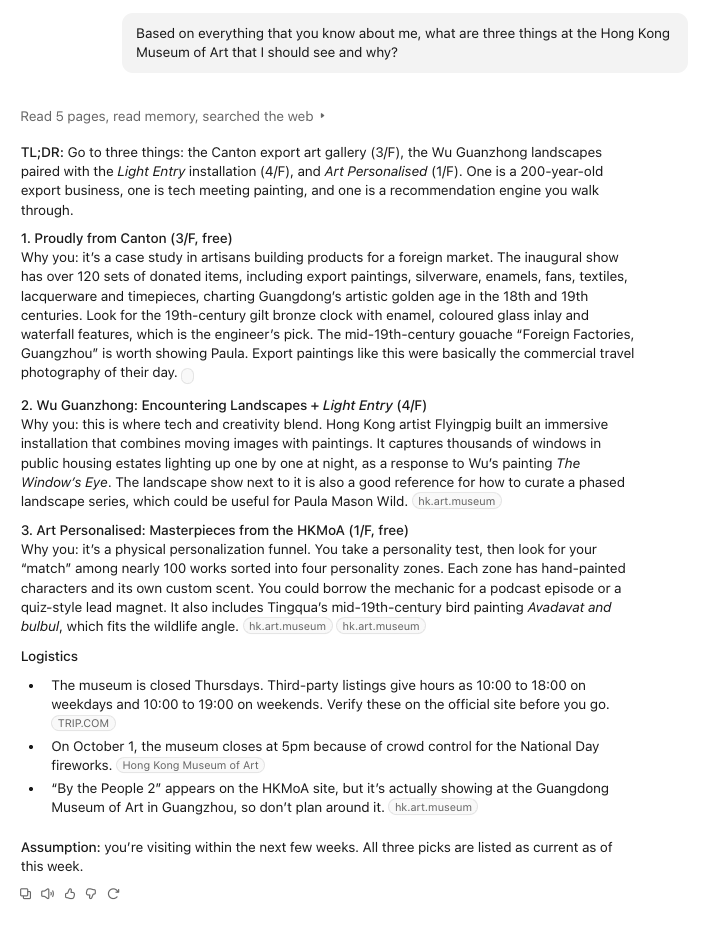
- The first was a gallery of things that Chinese artisans made for foreign buyers about 200 years ago. It said to find one gilt bronze clock, because that’s the engineer’s pick. The museum says the waterfall in its base is twisted glass rods turned by a gear to look like running water. I’m an engineer, so I found the clock, and the detail on it was truly remarkable.
- The second was an installation: thousands of windows in Hong Kong’s public housing lighting up one by one at night. In the “Why you” line it said this is where tech and creativity blend.
- The third it called a physical personalization funnel. It said I could borrow the idea for a quiz style lead magnet.
The way I read Claude’s answer is that I’m a manufacturing guy, and things that were manufactured a long time ago are very interesting to manufacturing guys like me. That’s not an insight I normally would have applied inside a museum. I do find the fine artisan stuff, the things that come out of bespoke manufacturing, considerably more interesting than straight up art in every museum that I visit. Now I think maybe I know why.
What was the museum’s personality test?
In the video: 4:20
That third pick was the part I really didn’t expect. In the Hong Kong Museum of Art there’s a screen on the wall that says personality test: find your exclusive art piece which best describes your characteristics and traits through a simple test of 12 questions.
This isn’t really AI. It was probably just a computer guided sort of quiz, the kind of pre-AI stuff that we’re used to seeing in marketing. You answer 12 questions, it tells you which kind of visitor you are, and then you go find the art in that exhibit that matches your answers. There are four types: Adventurer, Perfectionist, Elegance and Fashionista.
I took the test, and my result was Fashionista. At first I thought that’s a very strange word to describe me, because I’m usually wearing blue jeans and a polo shirt. But when I read the description, it made a lot more sense: “Full of quirky ideas, you often discover new and interesting things about everyday life and even historical objects.” That sounded a lot like innovation to me.
It’s the same museum, the same five floors for everybody. But every visitor to this exhibit gets their own way in.
Why did the custom answer work?
In the video: 6:07
Claude’s answer was better than a guidebook. With a guidebook, it’s up to me to take what I know about me, learn about the museum by reading the guidebook, and then find the intersection. Claude took what it knew about me and what it knew about the museum and found the intersection for me. It draws some conclusions, and then I can accept or reject them.
It also told me what to double check. It said the hours came from third party listings and to verify them on the museum’s website. And it was right to say so: the weekend closing time it listed was 7 p.m., and that night the museum was open until 9 p.m.
Your customers want that very same thing. In a 2021 McKinsey survey, 71% of consumers said they expect companies to personalize, and 76% get frustrated when that doesn’t happen.
How do you let Claude or ChatGPT know you?
In the video: 7:46
That answer was only that good because Claude already knew me. In Claude, that’s what the memory does, and it’s on the free plan right now. In ChatGPT, you’ll find it under Settings, Personalization.
Some people think it’s a little creepy that AI knows about them, and I guess it depends on your definition of creepy. When I think about how much information I disclose on LinkedIn, AI knows the same kind of things about me that people on LinkedIn know about me. For me, the benefits outweigh whatever the perceived cost of that lost privacy is by a mile, but I understand people may have a different opinion.
If you watched my last video and you built that business context file, you can give that to AI as well and then ask it, “What do you know about me?” Fix whatever it gets wrong. Then ask it this:
Based on everything you know about me, what are three things that I should do in my business, and why should I do them?
My recommendation is to ask for three, not 30. Ask for the why, not just for blind recommendations. And ask it to tell you what assumptions it’s making, because when it says why, you can see and verify its thinking, and accept, reject or correct it as you move along.
How do you personalize the customer experience with AI?
In the video: 10:35
Now that you have that power, you can turn it around and do the same thing for your customers. To a new customer, your business is just like that museum. It’s a lot of stuff and they don’t really know where to start.
Before AI, personalizing something for every customer meant you had to segment your email, send out a survey, track links, figure out who was who, and then make a bespoke lead magnet ahead of time for every different segment. That museum quiz works the very same way: the classification is done ahead of time, things are created ahead of time, and you funnel people to them.
With AI, you can classify in the moment and customize the customer’s experience on demand, based on what’s happening to them right then. It gives you the power to meet people where they are.
So how do you start? You start where you are.
- Three questions. Teach Claude about your business first (that’s the business context file from my last two videos). Then learn three things about a new customer, or ask them three simple questions. Paste their answers into Claude or ChatGPT and ask for the three things that fit this customer best, and why it thinks it’s a good fit. Read it, fix it, and send it to the customer in your own words.
- A quiz on your website, just like the museum’s. That doesn’t even need AI.
- An AI interview on your website that asks the questions of each person, changes the questions based on their answers in real time, and makes recommendations right then and there.
One rule for all three: AI only picks from what you really offer, and you check it before it goes out.
What’s the takeaway?
In the video: 13:54
I took what would have been an average museum visit and made it into a custom visit for me using Claude. You can do the same thing for your customers. Your customers walk into your business the same way that I walked into that museum. Show your customers the three things to see that are relevant to them, and tell them why.
What is Your First Three?
In the video: 14:37
That’s how my new lead magnet is set up. It’s an interview, not a predefined checklist or a PDF. The museum asked me 12 questions. Mine asks you seven, about your business and your AI journey. If you already use ChatGPT or Claude, there’s an optional first step: ask your AI what it knows about your business and paste that right in. Then it gives you three AI moves to make first, with the exact words to paste into ChatGPT or Claude.
Go to start.markmason.com. It’s free and it only takes about five minutes. Full disclosure: it’s going to want your email address. When you’re trying it, try it the way your customer would, then think about what your version of a similar lead magnet might look like.
Sources
- McKinsey and Company, “The value of getting personalization right, or wrong, is multiplying” (2021): 71 percent of consumers expect personalized interactions and 76 percent get frustrated when that doesn’t happen.
- Engadget, “Anthropic brings memory to Claude’s free plan” (March 2026).
- OpenAI, Memory FAQ: memory controls are under Settings, Personalization.
- Hong Kong Museum of Art: Art Personalised and Proudly from Canton. The museum’s weekend hours are 10:00 to 21:00.
- The previous video: Build This Once So Claude Knows Your Business.
About Mark Mason
Mark Mason leads engineering teams, including AI engineering, at a Fortune 500 semiconductor company. He has run online businesses since 2007 and has been podcasting since 2009. Practical AI for the business you already run: growth by design, not by grind.
Full transcript
AI for small business: a custom tour for every customer (0:00)
On a recent work trip to India I had a weekend in Hong Kong and while I was there I went to the Hong Kong Museum of Art. And I don’t know anything about art in Hong Kong. So I asked Claude, based on what you know about me, what should I go see? Now I’ve got a lot of Claude memory in my account so it already knew a lot about me and it gave me the three most important things to look at, and why.
It was specific to me. This turned what would have been an average visit and made it into a custom museum visit just for me. The unlock for you is that that’s how you should be using AI in your small business to give your customers that same custom tour feeling. By day, I lead engineering and AI teams at a Fortune 500 company.
By night, I run several small businesses, one of them with my wife. I’ll show you why that answer was so good and what AI for small business looks like when every customer gets their own tour.
I asked AI what to see in a museum (1:07)
The Hong Kong Museum of Art is a five story building with a lot of stuff inside like most museums. Now normally I like to pop in museums when I’m traveling. And I walked by this one several times in the past on previous trips, but I’d never gone in and honestly, I didn’t know what to expect. I didn’t know if it was a modern art museum, a cultural museum or a history museum.
So here’s what I spoke into Claude. Based on everything you know about me, what are three things at the Hong Kong Museum of Art, that I should see and why. It read its memory of me, searched the web and came back with three picks. Its first line said, One is a 200 year old export business.
One is a tech meeting painting and one is a recommendation engine that you actually walk through. And every pick that Claude made for me had a line underneath that said, why you? The first was a gallery of things that Chinese artisans made for foreign buyers. One of them about 200 years ago.
And it said to find one gilt bronze clock because that’s the engineer’s pick because of course I’m an engineer. The museum says the waterfall in its base is twisted glass rods turned by a gear to look like running water. And as I mentioned, I’m an engineer, so I found the clock. And the intricate detail on the clock was truly remarkable.
I assume because of when it was made, that everything like that was made by hand, carved by hand, which is completely unbelievable, given the level of detail and how accurately the pattern repeats. The way I read Claude’s answer is that I’m a manufacturing guy, And these things that were manufactured a long time ago, are very interesting to manufacturing guys like me. Now that’s not an insight that I normally would have applied inside a museum. Of course, I realized that about myself, but not in a museum context.
But I do find the fine artisan stuff The things that come out of bespoke manufacturing, considerably more interesting than straight up art in every museum that I visit. But now, I think maybe I know why. I never really took the time to think about it before. Claude said the export paintings were basically the commercial travel photography of their day.
And worth showing to Paula. Because as you know from watching the channel, my wife is a photographer. The second pick was an installation, thousands of windows in Hong Kong’s public housing lighting up one by one at night. In the why me section it said this is where tech and creativity blend.
And the third pick it called a physical personalization funnel. It said I could borrow the idea for a quiz style lead magnet. And I knew when I read that third pick, it was going to be a lot different than just wandering around a museum. That answer was really really strong.
A museum personality test: personalization before AI (4:20)
And that third pick The recommendation engine that you walk through in the museum. Was the part I really didn’t expect. In the Hong Kong Museum of Art, There’s a screen on the wall that says personality test at this exhibit. Find your exclusive art piece which best describes your characteristics and traits through a simple test of 12 questions.
AI was in this museum already and not really AI. This was probably just a computer guided sort of quiz, the kind of pre-AI stuff that we’re used to seeing in marketing. But in this case, you answer 12 questions and it tells you which kind of visitor you are and then you go find the art inside of this particular exhibit. That matches your answers.
There are four types, Adventurer, Perfectionist, Elegance and Fashionista. Each had its own part of the show and so I took the test and surprisingly my result was Fashionista. And at first I thought that’s a very strange word to describe me because I’m usually wearing blue jeans and a polo shirt, right? But when I read the description, it made a lot more sense, full of quirky ideas, you often discover new and interesting things about everyday life, and even historical objects.
That sounded a lot like innovation to me. What’s interesting is that this is the same museum, same five floors for everybody. But every visitor to this exhibit gets their own way in that’s special for them. And that’s interesting.
Because that’s how my lead magnet that I created based on this experience is set up and I’ll show you that a little bit later.
Why the custom answer worked (6:07)
Claude’s answer was actually better than a guidebook. Because with a guidebook, it’s up to me to take what I know about me and then learn about the museum by reading the guidebook and then find the intersection. Claude took what it knew about me and what it knew about the museum and found the intersection for me. That’s the magic of AI.
There’s no need for me to do that when Claude has all the data it needs. It draws some conclusions and then As a free agent, I can accept or reject them. In this case, the conclusions were pretty great. The part of that museum I saw matched my interest and improved my customer experience as a customer of the museum.
It gave me a way to look at the exhibits through my own lens in a way I might not have even considered before. It also told me what to double check. It said the hours came from third party listings and to verify them on the museum’s website. And it was right to say so.
The weekend closing time it listed actually was 7 p.m. And that night, the museum was actually open until 9 p.m. That’s how AI can enhance an experience or sometimes just simply get you to a better answer. And guess what?
Your customers want that very same thing. In a 2021 McKinsey survey, 71% of consumers said they expect companies to personalize and 76% get frustrated when that doesn’t happen.
Claude memory and ChatGPT personalization: let AI know you (7:46)
So what about you? Well, here’s the part you can do today. That answer was only that good because Claude already knew me. In Claude, that’s what the memory does.
And it’s on the free plan right now. In ChatGPT, you’ll find it under Settings, Personalization. Now some people think it’s a little creepy that AI knows about them and I guess it depends on your definition of creepy. For example, Facebook knows that I’m kind of interested in DIY plumbing reels.
Don’t ask me why I like to watch plumbing reels. I like to watch reels about fixing plumbing. So sometimes Facebook suggests really cool plumbing tools and sometimes I even buy them. What can I say?
I’m a DIY kind of guy. As a matter of fact, when I think about how much information I disclose on LinkedIn, AI knows the same kind of things about me that people on LinkedIn know about me. And for me, the benefits outweigh whatever the perceived cost of that lost privacy is by a mile, but I understand people may have a different opinion. That kind of raises the question, what’s your biggest fear about AI knowing things about you?
Tell me in the comments, I’m really interested to understand where you are on AI and privacy, but specifically, what is it that you’re worried about? Now if you watched my last video and you built that business context file, You can give that to AI as well and then ask it, what do you know about me? And then you can fix whatever it gets wrong and teach it so that the answers that AI gives you are really about you. Then once you’re to the point where you’ve got AI where it knows quite a bit about you and your business, Ask it this following very simple question.
Based on everything you know about me, What are three things that I should do in my business and why should I do them? What’s the benefit? And speaking of benefits, if you’re enjoying this content and you’d like to see more things like this, hit like and subscribe because it helps the channel. And more than that, it helps people find this content.
My recommendation when you’re asking Claude for recommendations is to ask for three, not 30. Ask the why not just for blind recommendations and ask you to tell it what assumptions it’s making when it makes those recommendations, because when it says why you can see and verify its thinking and accept or reject or correct its thinking as you move along. And when it’s wrong about you, you’ll see it right there and you can teach it how to be right the next time.
How to personalize the customer experience with AI (10:35)
Okay, so that’s all about you. But now that you have that power, you can turn it around. You can do the same kind of things that you’ve been doing for yourself and your business for your customers. To a new customer.
Your business is just like that museum. It’s a lot of stuff and they don’t really know where to start. Lead magnets are a great example. You write one great lead magnet for everybody.
And before AI, personalizing something for every customer meant you had to segment your email, send out a survey, track links, figure out who was who, and then make a bespoke lead magnet ahead of time for every different segment. If you wanted to talk to new people and experience people differently, you had to ask each one of them to classify themselves. That museum quiz in fact works in the very same way, the classification is done ahead of time and then things are created ahead of time and you funnel people to them. But now with AI, you can classify in the moment and customize the customer’s experience on demand based on what’s happening to them right then.
That’s a much more powerful idea and gives you the power to meet people where they are. You don’t have to figure out where they are way ahead of time. The moment you understand where a customer is, you can use AI to meet them there in that moment. So how do you start?
Well, you start where you are. For me, I’ve been using Claude since it came out. At this point, it almost knows more about my business than I do. I’ve forgotten things about my business that Claude reminds me of, and it often catches me making mistakes.
The first thing you need to do is teach Claude about your business so it can help you. Just like a trained employee would or maybe even an intern who had all the information they needed to do their job well. That’s the business context file that I referred to in my last two videos. Then you can simply learn three things about a new customer or ask them three simple questions about your business.
You can take their answers or that knowledge you have and paste that into Claude or ChatGPT with that business context file in memory. Then you can ask Claude for the three things that fit this customer best and why it thinks it’s a good fit. Then you read it, fix it and send it to the customer in your own words. Want to take it a little further?
The next step up is a quiz on your website just like the museum’s. That doesn’t even need AI And the next step after that is an AI interview on your website that asks the questions of each person, changes the questions and the answers based on the customer’s answers in real time and makes recommendations to the customer that are relevant to your business right then and there when the customer needs you most. One rule for all three cases, AI only picks from what you really offer and you check it before it goes out. That’s exactly what I’ve done with my new lead magnet and I’ll show you that in just a minute.
The takeaway: show every customer the three things (13:54)
So here’s the takeaway. I took what would have been an average museum visit, just another trip to a museum and made it into a custom visit for me using Claude. You can do the same thing for your customers. Your customers walk into the business the same way that I walked into that museum.
What you can do is show your customers the three things to see that are relevant to them and tell them why. The opportunity for you is that when a customer walks into your business or your website, you can show them the three things that they need to see based on who they are and what they need.
Your first three AI moves (start.markmason.com) (14:37)
And that’s how my new lead magnet is set up. It’s a demonstration for this video. It’s an interview and not a predefined checklist or a PDF. Really, it’s an AI channel.
And to be completely transparent, I’m doing it to show you the power of this technology. But I do think it’s a better way to meet people where they are. The museum asked me 12 questions. Mine asks you seven.
It’s about your business and your AI journey. If you already use ChatGPT or Claude, There’s an optional first step. Ask your AI what it knows about your business and paste that right in. In fact, I have a button on my lead magnet to help you do that.
Then it gives you three AI moves to make first, the smallest with the exact words to paste into ChatGPT or Claude, and in my lead magnet, I show you how to actually get started with AI. So go to start.markmason.com, it’s free and it only takes about five minutes. And full disclosure, it’s going to want your email address. It is a piece of marketing collateral, but I think it’s totally worth it.
After all, I’m exchanging the value of what the lead magnet produces. For the value of your email address so I can reach out to you in the future. When you’re trying it, try it the way your customer would, then think about what your version of a similar lead magnet might look like. The bottom line, AI can turn an average visit into a custom one for you and for every customer who walks in your door.
I’ll see you in the next video. Until next time. Ciao.


