
By Mark Mason. October 27, 2026. With the video (15:13) and its chapters below.
How do you stand out from your competitors when every one of them has the same AI that you do?
I was at an event with about 10,000 people, sitting in a hall waiting for my friend Pat Flynn to take the stage. Right at that moment, a kid and his dad sat down right behind me, and the kid turned to a total stranger and asked, “Do you have any extra cards?” What happened next is the part of your business that AI can’t copy. Let me tell you why.
If you want to know where to start with AI in your own business, I built something for that: Your First Three. It’s an AI interview, it’s free, and it asks for your email before it shows your plan.
Watch the video
How to Stand Out From Competitors When Everyone Has the Same AI (15:13)
- 0:00 How to stand out when every competitor has AI
- 0:37 Will AI make every business the same?
- 1:19 Pat Flynn’s Card Party, from an outsider
- 2:43 The kid, the stranger, and the Pokémon cards
- 7:00 What AI can’t replace: the human pieces
- 7:59 What AI can copy: voice clones and AI companions
- 10:07 How to be different in business when AI is everywhere
- 12:46 A prompt to find what makes your business stand out
- 14:30 Use AI for everything that doesn’t need you
Will AI make every business the same?
In the video: 0:37
Last week we talked all about AI and which tool you should be using, what your choices are, and how to pick. This week, we’re going to talk about what is still yours once everybody has all of the same AI tools.
Because really, if everybody is using AI, won’t all businesses end up the same? Everything will just become a bunch of AI-generated junk, right? It’s a fair worry, because your competitors are getting the same AI tools that you are, and they’re learning how to use them.
Recently I got my answer to this question in a place I didn’t expect: a Pokémon card event in Texas.
Pat Flynn’s Card Party, from an outsider
In the video: 1:19
Pat Flynn and I have been online business friends since I started online in 2007. He’s pretty famous for building Smart Passive Income, which is one of the best-known online business brands out there. We’ve been in the same weekly mastermind every Wednesday for more than a decade.
These days, Pat’s world is Pokémon. His Deep Pocket Monster channel and his companion channel, Short Pocket Monster, are well known worldwide and have millions of followers. As part of that brand, he has created a Pokémon card event called Card Party. It’s a trade show floor full of vendors, stage shows, a huge community of collectors, and importantly, also their families. It’s a spectacle.
The first Card Party only had about 1,500 people, but Pat’s continued to grow the event over the last several years, and this year in Dallas he had 10,000 people. He does this multiple times a year all across the United States.
Now, I’m not a Pokémon guy. My kids went through a Pokémon phase. I think it’s really cool. I collected baseball cards when I was a kid, so I sort of get it. But I’m really an outsider at an event like this.
The kid, the stranger, and the Pokémon cards
In the video: 2:43
In a way that only Pat Flynn can do, he struck a deal with the Gaylord Texan, which is a super fancy resort here in the Dallas area. In fact, it’s where my wife kidnapped me and took me for my 40th birthday as a surprise. That was some time ago.
He drew so many people to the event that there wasn’t even any parking at the hotel. I drove up and was greeted with signs that showed event parking off site. Then I took a fantastic shuttle bus, and there was a sea of people waiting to register for Pat’s event.
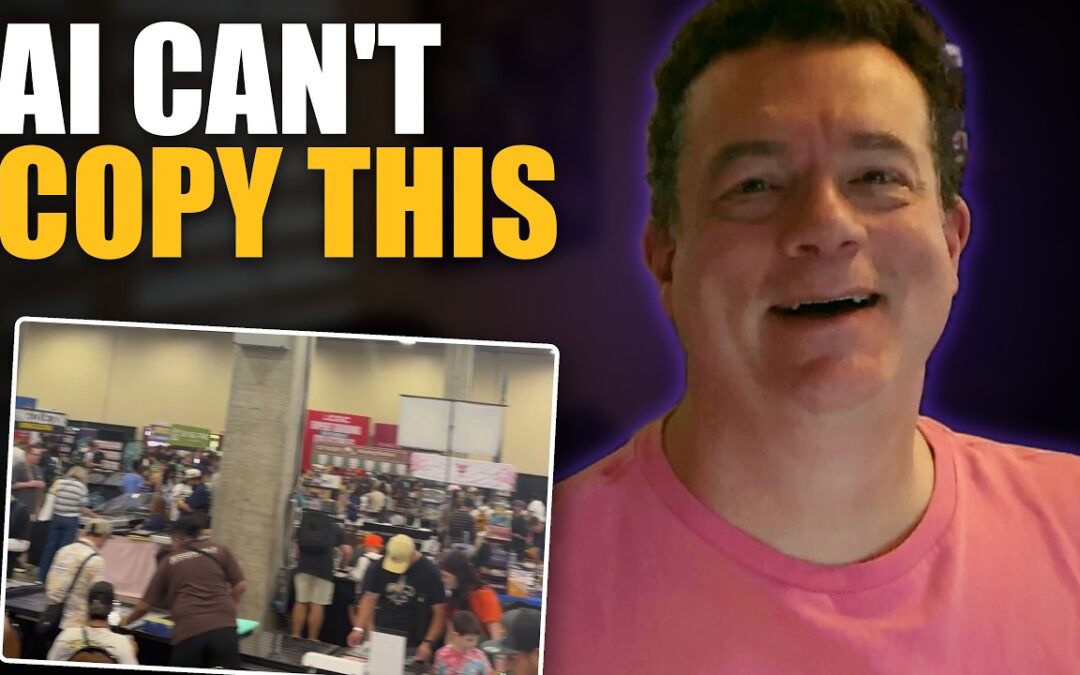
Then I went to the vendor floor, walked through these double doors, and actually thought I was in the wrong place. Thousands of people, hundreds of tables. It was a sea of humanity. It was so amazing. I took a 360-degree video on my phone, texted my mastermind and said, hey guys, Pat may be underselling this thing. Because he had created a sea of superfans. And if you haven’t read Pat’s book about superfans, that’s a must-read as well.
Behind the scenes with Pat’s superfans
After milling around with my mouth agape on the floor of the trade show for a while, I went upstairs to a behind-the-scenes event Pat was doing with his top fans. There were hundreds of people in there to understand how Pat actually makes his videos and to meet Pat’s staff. They were all speaking from the stage, and Pat was bringing his superfans up on stage.
The fans were finishing Pat’s sentences. They knew all of the inside jokes. To my surprise, they knew the video editor and some of the producers by name. It was the kind of intimacy you normally associate with things like podcasting. Pat’s video channel fans were all there, and they were really part of a bigger family.
And there was this binder guy there, a very famous man from one of Pat’s videos, who actually sold his binder to Pat to make some money. Pat finished the binder and was so moved by the guy’s story that he gave it back to him, and now he’s on stage at Pat’s event. All kinds of crazy things were going on, with kids in cosplay and parents chasing their kids around. The word I could come up with for it was wholesome family entertainment.
The scrapbook moment
So I’m sitting there in this room, waiting on this event to start with Pat on the center stage, and a kid and his dad walk into the room and sit down behind me. I can hear the conversation between this kid and the dad. The kid is super excited that his dad brought him to this amazing event. I’ll admit it, I was totally eavesdropping, because I was reminiscing about when I used to drag my kids around to stuff.
They were hunting, in this case, for these special event cards that were being handed out at the event. Honestly, I didn’t even know what these gold cards were that they were looking for. And the kid just turns to a total stranger, some guy sitting nearby, and asks him, “Do you have any extra cards that I can have?” Something only a kid could get away with, something that a kid would do.
Then they got into this long conversation, this kid and this other adult, and it turned out that the man did have extra cards. He gave them to the kid, the kid lit up, and the two of them just talked about what they were collecting.
That’s the kind of thing my wife Paula has a name for. She calls it a scrapbook moment. This dad had his kid at this event with all of these like-minded people who were in community with each other, and this was going to be etched on this kid’s mind like the page of a mental scrapbook.
That kid got one of those cards from a total stranger, and that is the kind of thing that AI simply can’t provide.
What AI can’t replace: the human pieces of your business
In the video: 7:00
So back to the question: if everybody has the same AI, how do you stay different? This is the moat. Look for the human pieces of your business: human interaction, human taste, person-to-person moments, community, face-to-face service.
There’s an old saying that I really like: people don’t usually remember what you did for them, but they always remember how you made them feel. AI can make someone feel heard in a chat window, but it can’t be the stranger in the next row who hands a kid a card, who does something special because they can.
A fun side note about the quote. That quote about people remembering how you make them feel is usually credited to Maya Angelou, but the earliest version on record is really from a guy named Carl Buehner, in 1971. Thought you should know.
What can AI copy? Voice clones and AI companions
In the video: 7:59
I feel really strongly about you looking for the human parts of your business as a way to differentiate, but this is also under attack by AI. There are already things that can clone your voice. ElevenLabs voice cloning is amazing. There are things that can clone videos, like HeyGen, and that is also getting better and better.
Now there are even services like Delphi that build an AI clone of an expert by ingesting all their videos, books and podcasts. These things can answer fans’ questions around the clock, in the expert’s cloned voice, and they can even do it in 40 different languages.
So yeah, AI probably can answer a question the way you would, from everything you’ve already said. But AI can’t go to a card show in Texas. It can’t sit in a hall and hear a kid ask a stranger for a card. In a lot of ways, AI can copy what I’ve said and tell you what I said before, but it can’t live what I’ll say next.
The feeling of a relationship
The other thing that’s under attack is the feeling of relationships. According to a Harvard Business Review article, therapy and companionship is now the number one way people use AI. About 1 in 10 adults use chatbots for emotional support, according to the American Psychological Association in 2026.
So the phrase “my customers are talking to me” isn’t a moat by itself anymore. A chatbot increasingly can be a good listener too, but what it can’t do is put real people together, like that kid and that stranger.
Here’s another thing to keep in mind. About 85% of consumers, at least right now, would rather talk to a real person than AI when they contact a business, according to AnswerConnect in May of 2026. Klarna recently split the difference by replacing 700 agents’ worth of work with AI, but then rehired people because they found the hard emotional calls were better handled by people.
How to be different in business when AI is everywhere
In the video: 10:07
So what does this mean? Here’s the takeaway. Use AI for everything that doesn’t need you, so there’s more of you that you can use in the moments that do need you.
Let’s take my business, for example: this very channel. I’m building it on my point of view, because that’s the part that AI can’t replace. I don’t even know what my point of view is going to be in three months. Everything is evolving so fast. AI can tell you what I’ve said, and it might be able to make a guess, a mixture of everything that’s going on on the internet, about what I might say about things that haven’t happened yet. But it doesn’t know. Only I get to decide that, and I get to share that with you.
There’ll be plenty of AI talking heads with AI opinions, and that’s absolutely fine. But Mark Mason’s point of view can only come from Mark Mason. Shoot, maybe in the end it’s only handfuls of people, but those are my people. They’re who I’m talking to, and they’re who I’m taking care of.
Everything else, the distribution, the transcripts, the busy work, that’s exactly where I use AI in my business. It’s like I explained in the last video: Claude drafts blog posts for my wife, for her personal brand, based on other content she’s already created, which she then edits to make them hers. Her photo sessions are scrapbook moments for the families she shoots. Where Paula adds value is composing shots, getting families at ease with their photo shoots, being present to take pictures, and of course editing those photos one at a time in a way that delights clients.
If you’re a plumber, an accountant or a shop owner
So what does this mean if you’re a plumber or an accountant or a shop owner trying to use AI in your business? It means you should use AI first in the non-human pieces of your business, like maybe accounting or bookkeeping or reading invoices or doing inventory, or other kinds of drudgery tasks that you absolutely have to do but don’t want to do. That frees you up to spend some time thinking about the human pieces of your business, like talking to customers.
One of my favorites: Paula rents lenses from a company that oftentimes writes her a handwritten note and includes a piece of candy in the box with the lens. AI can’t do that, but you can. You can learn your customers and care about them, because they will remember how you make them feel.
A prompt to find what makes your business stand out
In the video: 12:46
What’s the action for this week? Use AI to find the part of your business that AI can’t copy.
What you need is a prompt:
- Describe your business to AI, or skip that if your AI already knows about your business.
- Have it ask you up to five questions first, one at a time, about your business and what you do on a day-to-day basis.
- Have it split your work into AI work and human work.
- Ask AI for a short strengths, weaknesses, opportunities and threats analysis (we call this a SWOT analysis) on human connection versus AI for your business, for the tasks you’ve described.
- Then ask AI for three human moments in your business to either add or take advantage of, and pick one you can double down on this week.
I’ve already created this prompt for you. Here it is, and it’s also on its own page at markmason.com: The prompt: find the part of your business AI can’t copy. Copy it into ChatGPT, Claude, Gemini, or whatever AI you use.
I run [what kind of business] in [town or market]. My customers are [who they are]. (If your AI already knows your business, skip this line.)
Soon every one of my competitors will be using AI. I want to use AI to run leaner and serve customers faster, and I want to win on the human parts of my business that AI can’t easily copy.
Before you answer, ask me up to 5 questions about my business, one at a time, and wait for each answer.
Then: 1) Split the work in my business into two lists: work AI could do or speed up, and work where people, taste, relationships, or face-to-face moments are the reason customers choose me. 2) Give me a short SWOT on human connection versus AI in my business. 3) Recommend three specific ways to add human moments my customers would notice, including one I can start this week.
Be specific to my business. No generic advice.
The point is, you want to use whatever AI you’re using to identify a place in your business where you can start building a moat.
Here’s a pro tip from this approach that you should be using any time you use AI. Notice that we ask AI to ask you about your specific business before it answers. That’s the one move that makes answers come back specific to you, instead of getting back generic AI slop. That’s a whole method we’re going to talk about in a future video, and I’ll be excited to deliver that to you in the coming weeks.
Use AI for everything that doesn’t need you
In the video: 14:30
So here’s the takeaway. Use AI in your business for everything that really doesn’t need you, so that there’s more of you for the moments that do.
Next week we’ll get back to something a little more practical: how to set up Claude to do some tasks in your small business without doing any coding.
The bottom line
Your competitors are getting the same AI tools that you are, and they’re learning how to use them. The moat is the human pieces of your business: human interaction, human taste, person-to-person moments, community, face-to-face service. Use AI for everything that doesn’t need you, so there’s more of you for the moments that do. Learn your customers and care about them, because they will remember how you make them feel.
Sources
- Therapy and companionship as the top use of gen AI: Harvard Business Review, 2025 (summary on Forbes).
- About 1 in 10 adults use chatbots for emotional support: APA Monitor, 2026.
- About 85% would rather talk to a real person: AnswerConnect, May 2026.
- Klarna rehires people for the hard calls: CX Dive, May 9, 2025.
- The “how you made them feel” quote: earliest version on record, Carl Buehner, 1971.
- Pat Flynn’s book: Superfans.
About Mark Mason
Mark Mason leads engineering teams, including AI engineering, at a Fortune 500 semiconductor company. He has run online businesses since 2007 and has been podcasting since 2009. His YouTube channel, @MarkMasonCom, is practical AI for the business you already run: growth by design, not by grind.


